
Managing Wound Exudate and Drainage: Dressing Selection by Exudate Level
Assess wound exudate and match dressings to drainage level — light, moderate, heavy — in this clinical-education primer for nursing and therapy staff.
Wound Treatment & Management · 4 min read
Wound exudate is the fluid expressed through an open wound, produced in response to tissue injury. Its consistency varies, but it consists mostly of fluid and some of the components found in blood.
The amount of exudate is clinically significant when evaluating a wound. A wound bed that is too dry will arrest cell migration, whereas a bed that is too wet will macerate the periwound skin and raise the bacterial burden present in the wound.
The principle of moist wound healing lies between these two extremes, and selecting the correct dressing is crucial to maintaining that balance. Dressing selection should follow a physician's order and an established plan of care. The categories below are generic rather than brand-specific.
Read the Exudate First
Characterize the drainage according to three properties before selecting a dressing.
- Amount. Generally classified as none, light, moderate, or heavy. The practical proxy is the degree of dressing saturation observed at each change, along with the frequency of changes required.
- Color and consistency. Serous, meaning clear; sanguineous, meaning bloody; serosanguineous, meaning pink; or purulent, meaning thick and cloudy. Exudate that is purulent, or increasing sharply in volume, should trigger further clinical assessment.
- Trend. Exudate rising over the course of several days, or stopping abruptly, indicates that a change has occurred within the wound.
Assess the periwound skin as part of this process. Maceration, which presents as white, softened skin at the wound margins, indicates that the dressing is either failing to absorb the drainage adequately or failing to protect the margin.
Match the Dressing to the Drainage Level
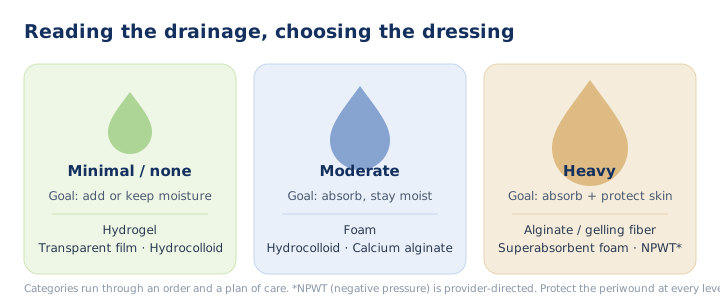
The general principle is to add moisture to a dry wound, absorb moisture from a wet wound, and protect the periwound skin at all times.
| Exudate level | Goal | Common dressing categories |
|---|---|---|
| Minimal or none | Keep the bed moist | Hydrogels (add moisture); transparent films; hydrocolloids |
| Moderate | Absorb while staying moist | Foams; hydrocolloids (lighter end); calcium alginates |
| Heavy | Absorb a lot, protect the periwound | Alginates and gelling fibers (hydrofiber-type); superabsorbent foams; provider-directed negative pressure wound therapy for very high output |
A periwound skin protectant, such as a barrier film or barrier cream, is often layered into the plan of care regardless of the exudate level present.
Practical Cautions
The volume of exudate a wound produces changes as the wound progresses, and it usually declines as the wound heals. The dressing selected should be adjusted to track that change. Reassessing the wound at each dressing change prevents both maceration and desiccation.
Drainage that is heavy or purulent, a wound with malodor, or exudate that is increasing alongside a worsening clinical picture all warrant a prompt change in the plan of care.
Certain wounds, including arterial ulcers and some dry necrotic wounds, are intentionally kept dry rather than moist as part of their management. Confirm the established plan of care before applying a moisture-retentive dressing to any wound.
Why Exudate Is a Team Skill
Managing exudate is a large part of the day-to-day work of a wound care clinician, since the amount of exudate heavily influences whether a wound progresses or stalls. Matching an appropriate dressing to the observed drainage is a core nursing competency, and one the bedside team exercises continually in the interval between provider rounds.
Key Takeaways
- A wound bed that is too dry will arrest cell migration, while a bed that is too wet will macerate the periwound and raise the bacterial burden.
- Characterize the amount, color and consistency, and trend of the exudate before selecting a dressing.
- Match the dressing category to the exudate level: add moisture, absorb drainage, and protect the periwound in either circumstance.
- Maceration at the wound margins indicates the dressing is either not absorbing adequately or not protecting the periwound.
- Purulent or malodorous drainage against a worsening clinical picture warrants review by a provider.
- Some wounds are intentionally kept dry; confirm the plan of care before applying a moisture-retentive dressing.
Clinical-education disclaimer: This article is for the continuing education of licensed clinicians and does not constitute medical advice or a treatment order. Dressing selection depends on the individual wound and patient and on a clinician's assessment.
Advance your wound care practice.
ProHealth One Institute offers a nationally accredited wound care certification with continuing education for nurses and therapists.
Explore the certification course ↗Related reading
Enzymatic Debridement: How It Works and When to Use It
A practical overview of enzymatic debridement, when it's appropriate, and how it compares with other debridement methods.
Types of Wound Debridement Compared (Autolytic, Enzymatic, Mechanical, Sharp, Biological)
A comparison of the five primary wound debridement methods, including when each is appropriate and how they differ in speed, selectivity, and clinical use.
Wound Odor Management: Causes, Assessment, and Clinical Options
What causes wound odor, how to assess it, and the clinical options for managing it — a practical primer for nursing and facility clinical staff.