
Pressure Injury Staging: Stage 1 Through 4, Unstageable, and Deep Tissue
A clinical refresher on the NPIAP pressure injury staging system, with practical guidance on the distinctions clinicians most commonly find challenging.
Procedures & Wound Types · 4 min read
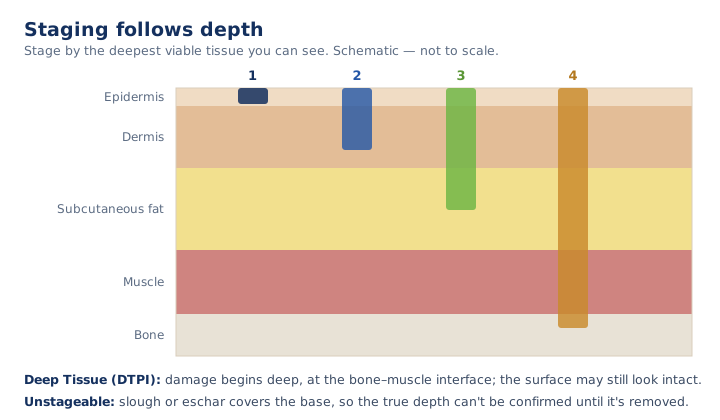
Pressure injuries are staged according to the deepest viable tissue visible in the wound. Accurate staging guides treatment, documentation, reimbursement, and survey readiness. This guide reviews the NPIAP staging system and highlights the distinctions clinicians most often encounter in practice.
Pressure Injury Staging at a Glance
| Stage | Key Finding | Commonly Confused With |
|---|---|---|
| Stage 1 | Intact skin with non-blanchable erythema | Deep Tissue Pressure Injury (DTPI) |
| Stage 2 | Partial-thickness skin loss with exposed dermis | Moisture-associated skin damage (MASD) |
| Stage 3 | Full-thickness skin loss with visible fat | Stage 4 |
| Stage 4 | Full-thickness tissue loss with exposed fascia, muscle, tendon, cartilage, or bone | Stage 3 |
| Unstageable | Full-thickness tissue loss obscured by slough or eschar | Stage 3 or Stage 4 |
| Deep Tissue Pressure Injury (DTPI) | Persistent deep red, maroon, or purple discoloration or blood-filled blister | Stage 1 |
A Note About Terminology
In 2016, the National Pressure Injury Advisory Panel (NPIAP, formerly NPUAP) updated its terminology. "Pressure ulcer" became pressure injury because Stage 1 injuries and deep tissue pressure injuries are not open ulcers. Roman numerals were also replaced with Arabic numerals, although older documentation may still use terms such as "Stage III."
Stage 1
Stage 1 pressure injuries present as intact skin with localized, non-blanchable erythema, usually over a bony prominence.
The affected area may be warmer or cooler than surrounding skin, firmer or softer to the touch, and tender or painful.
In darker skin tones, color changes may be subtle. Temperature, firmness, tenderness, and non-blanchable discoloration often become more important than redness alone.
Key point: The skin remains intact.
Stage 2
Stage 2 injuries involve partial-thickness skin loss with exposed dermis. The wound bed is pink or red, moist, and may appear as an intact or ruptured serum-filled blister.
There is no slough, eschar, granulation tissue, or exposed deeper structures.
Stage 2 injuries are commonly confused with moisture-associated skin damage (MASD). Consider the location, pressure history, and presence of shear when making the distinction.
Stage 3
Stage 3 injuries involve full-thickness skin loss.
Subcutaneous fat may be visible. Granulation tissue, epibole, undermining, and tunneling may also be present.
Muscle, tendon, fascia, cartilage, and bone are not exposed.
Depth varies by anatomical location because some areas have very little subcutaneous tissue.
Stage 4
Stage 4 injuries involve full-thickness skin and tissue loss with exposed or directly palpable fascia, muscle, tendon, ligament, cartilage, or bone.
Undermining and tunneling are common, and osteomyelitis should be considered when clinically appropriate.
The defining difference from Stage 3 is exposure of deeper supporting structures.
Unstageable Pressure Injury
An unstageable pressure injury is a full-thickness wound whose true depth cannot be determined because slough or eschar completely obscures the wound base.
Once enough nonviable tissue has been removed to visualize the base, the wound is staged according to its actual depth.
Exception: Stable, dry, adherent eschar on an ischemic heel or limb generally should not be removed because it serves as the body's natural protective covering.
Deep Tissue Pressure Injury (DTPI)
Deep tissue pressure injuries present as persistent, non-blanchable deep red, maroon, or purple discoloration or as a blood-filled blister.
Tissue damage begins beneath the skin because of prolonged pressure and shear, often before surface changes become visible.
Pain, temperature changes, and tissue firmness may precede discoloration.
DTPI may resolve without tissue loss or rapidly evolve into a full-thickness pressure injury despite appropriate care.
The most common diagnostic error is confusing DTPI with Stage 1 pressure injury.
Common Staging Mistakes
| Common Mistake | How to Differentiate |
|---|---|
| Stage 1 vs. DTPI | DTPI presents with deep maroon or purple discoloration rather than superficial non-blanchable erythema. |
| Stage 2 vs. MASD | Consider pressure history, location over bony prominences, and wound characteristics. |
| Stage 3 vs. Stage 4 | Exposure of fascia, muscle, tendon, cartilage, or bone indicates Stage 4. |
| Unstageable vs. Stage 4 | If slough or eschar obscures the wound base, the injury remains unstageable until the true depth is visible. |
Important Staging Rules
- Pressure injuries are never reverse staged.
- A healing Stage 4 remains a healing Stage 4.
- Mucosal pressure injuries cannot be staged using the NPIAP skin staging system.
- Medical device-related pressure injuries are staged using the standard NPIAP classification when applicable.
Accurate staging improves communication, guides appropriate treatment, supports defensible documentation, and promotes consistent care across the clinical team. When staging is uncertain, consultation with another experienced clinician can improve accuracy and consistency.
Advance your wound care practice.
ProHealth One Institute offers a nationally accredited wound care certification with continuing education for nurses and therapists.
Explore the certification course ↗Related reading
Chemical Cauterization with Silver Nitrate: Managing Hypergranulation Tissue
How silver nitrate chemical cauterization manages hypergranulation tissue: mechanism, technique, frequency, and the contraindications to know.
Diabetic Foot Ulcers: Risk, Assessment, and the Care Team
A clinical overview of diabetic foot ulcer prevention, risk assessment, examination, and the multidisciplinary care needed to preserve limb function.
Peristomal Skin and Ostomy Care Basics
A practical guide to assessing the stoma, protecting peristomal skin, achieving a reliable appliance seal, and recognizing when specialty ostomy care is needed.