
Why Wounds Heal Slowly in Older Adults
Why wounds heal slowly in older adults — how aging skin, comorbidities, perfusion, and nutrition stall healing in the SNF and long-term care population.
Wound Healing Fundamentals · 6 min read
Factors That Slow Healing at a Glance
| Factor | Effect on healing | Fixed or assessable |
|---|---|---|
| Aging skin | Fragility, less collagen, slower turnover, altered inflammatory response | Fixed |
| Perfusion and oxygen | Too little tissue oxygen for collagen synthesis and immune function | Assessable |
| Diabetes | Impaired immunity, unperceived trauma, reduced perfusion | Assessable |
| Nutrition and hydration | Material demands of repair unmet | Assessable |
| Pressure, mobility, moisture | Pressure over bony prominences, less circulation, weakened skin barrier | Assessable |
| Medications and comorbidities | Blunted inflammatory and proliferative response, less reserve | Assessable |
Aging Changes the Skin
Normal aging and its effect on the skin can contribute to slow wound healing in the absence of any pathologic condition. This delay occurs in healthy geriatric patients independent of comorbid disease and reflects intrinsic changes in the skin itself.
Skin in geriatric patients tends to be thinner than in younger individuals, mostly because collagen deposition decreases with age. The dermal-epidermal junction also flattens, which increases fragility and is one reason geriatric patients are at increased risk of skin tears and shear injury.
Along with producing less collagen, aging skin undergoes a slower rate of cellular turnover, meaning both the matrix deposition and resurfacing steps of the proliferative phase proceed more slowly than in a younger patient. The inflammatory response becomes altered and is often less efficient in older adults, and reparative cell populations respond more sluggishly to the recruitment signals that would otherwise draw them to the wound.
None of these changes mean an older adult's wound is incapable of healing. They mean the margin for error is narrower in this population, and the modifiable factors below carry correspondingly greater weight.
Perfusion and Oxygen
Wound healing is an oxygen-dependent process. Several of its core steps, including collagen synthesis and the bactericidal function of immune cells, require an adequate supply of tissue oxygen, and that supply depends on adequate perfusion.
Older adults are considerably more likely than younger patients to carry the conditions that compromise perfusion: peripheral arterial disease, chronic venous insufficiency, heart failure, and the small-vessel damage associated with long-standing diabetes.
A wound on a poorly perfused lower limb will not heal through dressing selection alone, however appropriate that dressing may otherwise be. For this reason, vascular assessment is mandatory for any lower-extremity wound. An arterial wound managed as though it were a venous wound can be made worse by that error, particularly if compression therapy is applied to a limb that is ischemic.
Diabetes
Diabetes warrants separate discussion, as it slows healing through several mechanisms that occur concurrently.
- Glycemic control. Poor control impairs the function of immune cells and thereby raises the risk of infection.
- Neuropathy. A patient may be unable to perceive the pressure or trauma creating or re-injuring the wound, and as a result the wound continues to reopen.
- Vascular disease. The vascular disease that frequently accompanies diabetes reduces perfusion to the affected area.
Taken together, these three mechanisms make the diabetic foot ulcer one of the most difficult wounds to close, and one of the wounds with the highest stakes when mismanaged.
Nutrition and Hydration
Tissue repair places substantial material demands on the body.
- Protein. Adequate intake supports both collagen synthesis and immune function.
- Calories. Sufficient caloric intake spares protein for repair rather than requiring it to be used for energy.
- Micronutrients, including vitamin C and zinc, support individual steps within the healing cascade.
- Hydration supports both perfusion and overall tissue integrity.
Malnutrition is common in the long-term care setting and frequently underrecognized. It both slows the rate of healing and raises the risk of new skin breakdown elsewhere. When a wound fails to progress despite otherwise adequate local wound care, that finding should prompt a review of the resident's intake, weight trend, and overall nutritional status, ideally in conjunction with a dietitian.
Pressure, Mobility, and Moisture
Reduced mobility is a defining feature of the long-term care population, and it opposes wound healing in two distinct ways.
- It concentrates pressure over bony prominences, which both creates new pressure injuries and prevents existing ones from healing when offloading is inadequate.
- It limits the physical activity that would otherwise support circulation.
Combined with incontinence-associated moisture, which weakens the skin barrier and raises the risk of breakdown, these conditions together produce many of the wounds managed within these facilities.
Consistent offloading, repositioning, and moisture management should not be regarded as adjuncts to care in this setting. They are frequently the determining factor between a wound that heals quickly and one that becomes a chronic, non-healing wound.
Medications and Comorbidities That Compound the Problem
Several common situations within this population impose further drag on healing:
- Corticosteroids and certain immunosuppressants can blunt the inflammatory and proliferative responses upon which healing depends.
- Polypharmacy and multiple concurrent chronic conditions impose competing physiological demands and reduce the reserve available for tissue repair.
- Cognitive impairment can render a resident less able to report pain, cooperate with offloading measures, or avoid activities that disturb the wound.
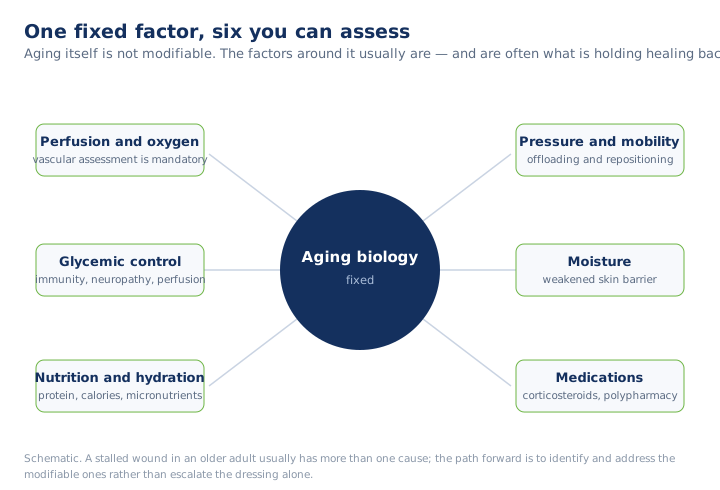
The objective in reviewing this list is not to commit it to memory, but to recognize that a stalled wound in an older adult usually has more than one contributing cause. The appropriate path forward is to identify and address the modifiable factors present, rather than to escalate the dressing regimen alone.
What This Means at the Bedside
A chronic, non-healing wound in a geriatric patient should prompt the clinician to look beyond the wound bed itself.
The biology of aging cannot be changed, but perfusion, glycemic control, nutrition, pressure, moisture, and medication effects can all be assessed, and many can be modified. In this population, the wounds that ultimately close are usually those in which a member of the care team identified the specific systemic factor holding healing back.
For the bedside signs that indicate a wound has stalled in the first place, see signs a wound is healing vs. stalling.
Key Takeaways
- Aging alone slows healing, so the margin for error in older adults is narrower.
- Vascular assessment is mandatory for lower-extremity wounds; compression on an ischemic limb can worsen an arterial wound.
- Diabetes slows healing through glycemic control, neuropathy, and vascular disease at once.
- Malnutrition is common and underrecognized in long-term care; a stalled wound warrants nutritional review.
- Offloading, repositioning, and moisture management are frequently decisive in this population.
- A stalled wound in an older adult usually has more than one cause; address the modifiable ones rather than escalating the dressing alone.
Clinical-education note: This article is general education for clinicians and does not replace facility protocol, physician orders, individualized assessment, or the input of a wound-care specialist, dietitian, or vascular evaluation where indicated.
Advance your wound care practice.
ProHealth One Institute offers a nationally accredited wound care certification with continuing education for nurses and therapists.
Explore the certification course ↗Related reading
The Stages of Wound Healing: A Clinical Refresher
A clinically grounded review of the four stages of wound healing — the tissue-level events, expected timing, and the findings that signal a stalled wound.
The Phases of Wound Healing: Hemostasis, Inflammation, Proliferation, Remodeling
A mechanism-level review of the four phases of wound healing — the cells, signals, and processes underlying hemostasis, inflammation, proliferation, and remodeling.
Signs a Wound Is Healing vs. Stalling: What Clinicians Watch For
How to distinguish a healing wound from a stalled one at the bedside — the signs of progress, the signs of trouble, and when to escalate.